
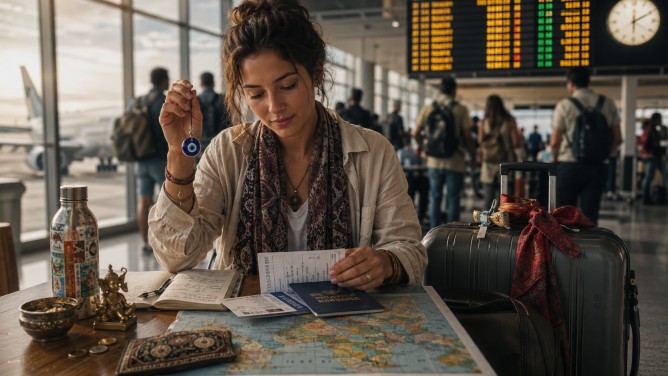
Travel rituals and superstitions have woven themselves into the tapestry of cultural practices around the world, offering travelers a sense of comfort and connection as they embark on their journeys. Many of these customs are aimed at attracting luck and ensuring safety during travel. For instance, in parts of the Balkans, placing a clove of garlic in luggage is a common practice believed to ward off bad luck and protect against negative energy. Similarly, a simple gesture like touching the outside of an aircraft before boarding is a ritual that some travelers follow for good luck, especially those who might feel nervous about flying.
Another widespread belief is starting a journey on the “right foot,” quite literally. Travelers often step onto an airplane with their right foot first, as it’s thought to bring good fortune for the trip ahead. Meanwhile, in regions such as the Middle East and the Balkans, families may pour or sprinkle water behind a departing traveler. This act symbolizes a smooth and safe journey, with the hope of a safe return, much like the flowing water that signifies ease and continuity.
Numbers also play a significant role in travel superstitions across various cultures. In many Western countries, the number 13 is famously avoided due to its unlucky connotations. In contrast, the number 4 is considered unlucky in China because its pronunciation is similar to the word for death. Italy has its own numeral superstition, with the number 17 traditionally seen as a harbinger of misfortune. These beliefs can influence choices such as hotel room numbers and floor levels in buildings.
Some customs involve a more personal reflection before a journey. A notable Slavic tradition involves sitting on one’s packed luggage for a short period before departure. This pause offers a moment for travelers to gather their thoughts and mentally prepare for their trip. Conversely, in several cultures, sweeping the floor immediately after someone leaves is thought to sweep away their good fortune or disrupt their safe return.
While these travel superstitions lack scientific proof, they remain a fascinating aspect of cultural identity and personal rituals. They serve as reminders of the deep-seated traditions that bring excitement and a sense of belonging to the journey, reflecting more on preserving cultural heritage than testing the efficacy of superstitions.